The Kioti CK series (including the CK2510, CK2610, CK3510, and CK4010) are well-built compact tractors, but like any diesel engine, they develop predictable problems over time. Knowing what to look for puts you ahead of costly breakdowns.
Most engine problems on Kioti CK series tractors follow recognisable patterns. Whether your machine is struggling to start, overheating, blowing smoke, or losing power, the cause usually comes down to a handful of components. This guide walks through the most common issues reported by CK series owners, how to diagnose each one, and what parts are typically involved in the fix.
PROBLEM # 1:
Engine hard to start or won't start
This is one of the most frequently reported issues across the CK range, particularly in cold conditions or on higher-hour machines. The engine may crank normally but fail to fire, or it may start briefly and then stall.
Likely Causes
ℹ️ Faulty or weak glow plugs
ℹ️ Failed preheat relay
ℹ️ Clogged fuel filter
ℹ️ Faulty fuel stop solenoid
ℹ️ Water contamination in fuel
ℹ️ Weak or dead battery
How to Diagnose
✅ Check battery voltage (should read 12.5V+)
✅ Test each glow plug with a multimeter
✅ Swap the preheat relay with the headlamp relay, same part on many CK models
✅ Inspect fuel filter for blockage or discolouration
✅ Manually push the stop solenoid plunger to see if the engine fires
📌 Owner Tip: A faulty preheat relay is a surprisingly common cause of cold-start failure on CK series tractors. On many models, the preheat and headlamp relays are identical, swapping them takes five minutes and confirms the fault instantly without buying any parts.
Overheating is a serious condition that can cause warped cylinder heads and permanent engine damage if the tractor continues to be operated. If the temperature gauge enters the red zone, stop the engine immediately.
Likely Causes
ℹ️ Low or depleted coolant level
ℹ️ Clogged or dirty radiator fins
ℹ️ Faulty thermostat (stuck closed)
ℹ️ Failed or worn water pump
ℹ️ Damaged fan belt
ℹ️ Coolant leak in hoses or gaskets
How to Diagnose
✅ Check coolant level in reservoir first
✅ Inspect radiator fins and blow out with compressed air if clogged
✅ Check fan belt tension and condition
✅ With engine cold, feel both radiator hoses after warm-up. If top hose is hot but bottom is cold, thermostat may be stuck
✅ Inspect water pump for weep hole leakage
⚠️ Do not remove the radiator cap when the engine is hot. Coolant is under pressure and can cause serious burns. Always allow the engine to cool fully before inspecting the cooling system.
Parts commonly needed: thermostat, water pump, radiator hoses, coolant refill.
A CK series tractor that feels sluggish under load, struggles on slopes it used to handle easily, or runs at reduced RPM is showing classic signs of a fuel delivery or air supply problem. This issue is common on machines with 500+ hours.
Likely Causes
ℹ️ Clogged air filter
ℹ️ Blocked or degraded fuel filter
ℹ️ Worn or dirty fuel injectors
ℹ️ Stale or contaminated diesel
ℹ️ Clogged fuel tank screen
How to Diagnose
✅ Inspect air filter and replace it if it’s grey or clogged
✅ Replace fuel filter as a first step
✅ Check the fuel for contamination or sediment
✅ Listen for uneven idle which may indicate injector issues
✅ Bleed the fuel system after filter replacement
📌 Note on fuel quality: Diesel stored for more than 6–12 months can degrade and form sediment that clogs fuel filters and injectors. If the tractor sits over winter, drain old fuel or use a diesel stabiliser.
Parts commonly needed: air filter, fuel filter, fuel injectors.
Smoke colour is one of the most useful diagnostic tools on a diesel engine. Different colours point to different problems.
⬛ Black smoke
ℹ️ Running rich — too much fuel
ℹ️ Clogged air filter starving combustion
ℹ️ Faulty or worn injectors
ℹ️ Check and replace air filter first
⬜ White / Blue smoke
ℹ️ White on cold start = normal (condensation)
ℹ️ Persistent white = coolant entering combustion (head gasket)
ℹ️ Blue smoke = oil burning (worn piston rings or valve seals)
ℹ️ Requires urgent investigation
⚠️ Persistent white or blue smoke is a serious warning. Continued operation with a suspected head gasket failure or worn piston rings will cause rapid engine damage. Get a compression test done before running the tractor again.
Parts commonly needed: air filter, injectors, head gasket set, piston rings (depending on diagnosis).
If the oil pressure warning light comes on while the engine is running, this requires immediate attention. Do not continue operating the tractor because low oil pressure can destroy engine bearings within minutes.
Likely Causes
ℹ️ Low oil level. Check dipstick first
ℹ️ Wrong oil viscosity for conditions
ℹ️ Faulty oil pressure sender unit
ℹ️ Worn oil pump
ℹ️ Blocked oil pickup strainer
ℹ️ Internal engine wear
How to Diagnose
✅ Check oil level on dipstick immediately
✅ Top up if low and recheck warning light
✅ If level is fine, suspect the oil pressure sender
✅ Test with a mechanical gauge for a true reading
✅ If confirmed low pressure, do not run as engine rebuild may be needed
Parts commonly needed: oil pressure sender unit, oil filter, engine oil.
Kioti CK series tractors can develop electrical gremlins, particularly on older machines exposed to moisture and vibration. Common symptoms include the battery light staying on, failure to crank, or intermittent warning lights.
Likely Causes
ℹ️ Corroded battery terminals
ℹ️ Worn or failing alternator
ℹ️ Loose or damaged wiring connectors
ℹ️ Battery past its service life (4–5 years typical)
ℹ️ Faulty charging relay
How to Diagnose
✅ Clean battery terminals as corrosion causes voltage drop
✅ Test battery voltage: 12.5V+ at rest, 13.8–14.4V with engine running (alternator charging)
✅ Inspect wiring harness connectors for corrosion or loose pins
✅ If battery light persists with good voltage, suspect alternator
Parts commonly needed: battery, alternator, starter motor, wiring connectors.
Most of the problems above can be tackled by a confident owner with basic tools, especially fuel filter changes, air filter replacements, glow plugs, and relay swaps. Where it makes sense to get professional help is when the diagnosis points to internal engine issues: low compression, persistent white or blue smoke, or confirmed low oil pressure after topping up. These require engine-out work and specialist tools.
When ordering parts, always have your engine serial number ready. The CK2510, CK3510, and CK4010 share similar engine architecture but have different part numbers across production years, especially for gaskets, injectors, and filters. Our team can confirm compatibility before dispatch so the right part arrives first time.
Using the wrong oil grade or leaving it too long between changes is one of the fastest ways to shorten the life of a Kioti Daedong engine. This guide covers the correct oil specification, capacity, and change intervals for the most popular CK, DK, and CS series models.
Whether you own a compact CK2510 or a mid-range DK series tractor, getting the oil right is non-negotiable. Kioti’s Daedong engines are robust and long-lasting, but they rely on clean, correctly rated oil to maintain oil pressure, cool internal components, and protect against wear. Here’s everything you need to know, broken down by model.
What oil spec does a Kioti tractor need?
The oil specification required depends on your model year and whether your tractor is fitted with a DPF (Diesel Particulate Filter) exhaust system.
Model / Year range
Emission tier
Required API spec
Viscosity
CK series 2015–2020
Tier 2/3 – no DPF
API CH-4 or higher
SAE 10W-30, 10W-40, or 15W-40
CK series 2021–present
Tier 4 – with DPF
API CJ-4 or higher
SAE 15W-40 (or 5W-40 in cold climates)
DK series (all years)
Tier 3/4
API CI-4 or higher
SAE 15W-40 recommended
CS series (compact)
Tier 2/3
API CH-4 or higher
SAE 10W-30 or 15W-40
⚠️ Important for DPF-equipped tractors (2021+): Do not use API CH-4 oil in a Tier 4 DPF engine. DPF systems require low-sulphated-ash oil (API CJ-4 or CK-4). Using the wrong grade can block the filter prematurely and result in costly repairs.
Oil capacity by model (with filter change)
Always measure oil capacity with a new filter installed, as the filter holds a small additional quantity of oil.
Model
Engine
Capacity (litres)
Capacity (gallons)
CK2510 / CK2610
3-cyl Daedong 1.6L
5.8 L
1.53 gal
CK3510 / CK3520
3-cyl Daedong 1.8L
5.8 L
1.53 gal
CK4010 / CK4020
3-cyl Daedong 1.8L
5.8 L
1.53 gal
CS2510 / CS2520
3-cyl Daedong 1.1L
3.0 L
0.79 gal
DK35 / DK40
4-cyl Daedong
7.0–7.5 L
~1.9 gal
DK45 / DK50 / DK55
4-cyl Daedong
7.5–8.0 L
~2.0 gal
DK60 / DK65
4-cyl Daedong
8.0–9.0 L
~2.1–2.4 gal
⚠️ Always verify with your engine serial number. Capacities can vary slightly between production years of the same model. When in doubt, fill to the lower dipstick mark, run the engine for 30 seconds, let it settle, then top up to the upper mark.
Oil change intervals by model
Kioti and Daedong service schedules follow a consistent pattern across most models, with one important exception — the first oil change on a new tractor.
Service point
CK series
DK / CS series
Notes
First oil change (break-in)
50 hours
50 hours
Critical — metal particles from break-in must be removed
Regular interval
Every 100 hours
Every 100 hours
Change oil filter at every oil change
Maximum interval
1 year
1 year
Even if 100 hours has not been reached
Hydraulic filter
Every 200 hours
Every 200 hours
Hydraulic oil change at 400 hours
Tractor owners who only use their machine seasonally (say 70–80 hours per year) should still change the oil annually regardless of hours, as oil degrades over time from moisture and combustion by-products even when the tractor sits idle.
Cold climate considerations
Standard 15W-40 oil can thicken in very cold temperatures, making cold starts harder and increasing wear on engine components. If you operate in temperatures regularly below -10°C (14°F), consider switching to a 5W-40 full synthetic oil that meets the same API spec for your model. This provides better flow at start-up while still protecting at operating temperature.
Signs your Kioti engine oil needs attention
Don’t rely solely on the hour meter. These are signs your oil may need changing ahead of schedule:
📌 The oil appears very dark or black on the dipstick.
📌 Oil that smells burnt or has a fuel odour.
📌 White or milky colouring, which may indicate coolant contamination.
📌 Excessive engine noise at start-up, suggesting oil pressure is slow to build.
If you notice any of these, change the oil and filter immediately and investigate the root cause before returning to work.
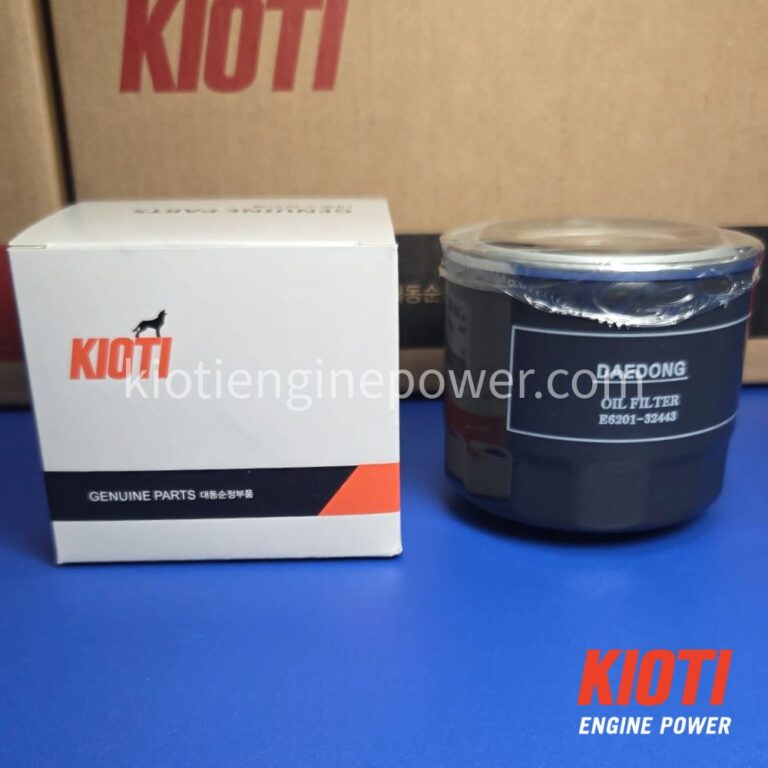
Keeping your oil filter in stock
The oil filter should be replaced at every engine oil change. It’s a low-cost part that plays a critical role in keeping the oil circuit clean. Kioti CK and DK series filters are model-specific, so it’s worth keeping a spare on the shelf. Always confirm the filter part number against your engine serial number before ordering, as filter specifications changed between production runs on some models.
If you’re unsure which oil filter fits your tractor, get in touch with our team with your engine serial number and we’ll confirm the correct part before dispatch.
The Kioti CK2510 uses a set of standardised symbols across its instruments and controls. Knowing what each one means can save you from costly breakdowns and keep you safe in the field.
If you’ve just taken delivery of a Kioti CK2510, that dashboard can look a little cryptic at first. Compact utility tractors pack a lot of monitoring capability into a small instrument panel, and the symbols used are based on international standards, meaning they’re broadly consistent across many makes and models.
The good news is that once you learn them, they’re intuitive. Here’s a breakdown of every universal symbol listed in the official CK2510 operator manual.
The complete symbol reference
Here are all 16 universal symbols documented for the CK2510, grouped by function:
Fuel Level
Monitors remaining fuel in the tank
Engine Coolant Temperature
Indicates coolant is overheating
Engine Oil Pressure
Low oil pressure warning. Stop immediately
Parking Brake
Confirms the parking brake is engaged
Differential Lock
Rear axle differential is locked
Turn signal
Left or right indicator is active
Battery Charging Condition
Alert for charging system fault
Position Control – Lowering
3-point hitch is lowering
Headlight – Low Beam
Dipped headlights are on
Headlight – High Beam
Full beam headlights are active
Hazard Warning Lights
All four indicators flashing
Four-wheel drive on
Front axle engagement is active
Power Take - ON Clutch Control - OFF
PTO engagement clutch (live/on position) is currently disengaged.
Power Take - OFF Clutch Control - OFF
PTO is fully switched off and disengaged from the drivetrain.
Coolant Refill Warning Lamp
Coolant level is critically low
Preheat
Glow plugs are warming up. Wait before starting
Which symbols need immediate attention?
Not all warning lights are equal. Some are informational (e.g. turn signal, high beam), while others signal a condition that can cause serious engine damage if ignored. The ones to act on immediately are:
⚠️ Engine Oil Pressure — If this comes on while running, shut down the engine as soon as it’s safe to do so and investigate before restarting.
⚠️ Engine Coolant Temperature — Continued operation when overheating can warp the cylinder head. Stop, let it cool, and check the coolant level.
⚠️ Coolant Refill Warning Lamp — Topping up promptly prevents the temperature warning from triggering in the first place.
⚠️ Battery Charging Condition — A persistent battery light usually points to a faulty alternator or a loose belt. Left unaddressed, the tractor will eventually stall and not restart.
Finding the right parts when a warning light comes on
A warning symbol is often the first sign that a component is wearing out or has already failed. Common culprits behind CK2510 warning lights include the alternator belt, coolant hoses, oil pressure sender units, and glow plugs. When sourcing replacements, always confirm compatibility with your engine serial number. The CK2510 was produced with slightly different engine variants over its production run.
If you’re unsure which part you need, our team is happy to check compatibility before dispatch. Just get in touch with your tractor’s engine number and we’ll confirm the correct part.